
The marketers who will pull ahead in 2027 are not the ones collecting the most AI tools. They know one channel deeply and have taught agents to carry that knowledge. Here is the six-step system I use, and the three places a human must always say yes.
I have spent more than 15 years in performance marketing. For most of that time, growth meant more people, more hours or more budget. Over the last year that changed for me. Today my own brand and ventures run on a small set of AI agents, and the way I set them up has settled into a repeatable system. This post explains it step by step, so you can build your own without a big team or a big budget.
What is a marketing engineer?
A marketing engineer is a marketer who builds systems instead of only doing tasks. They know a channel well enough to judge good work, and they turn that judgement into workflows that AI agents run: research, drafting, testing and reporting. The human sets the standard and approves the output. The agents do the volume.
It is not a developer who happens to work in marketing. The craft comes first. The engineering is how you scale the craft.
Agents multiply whatever you already know. If you know nothing, they multiply nothing.
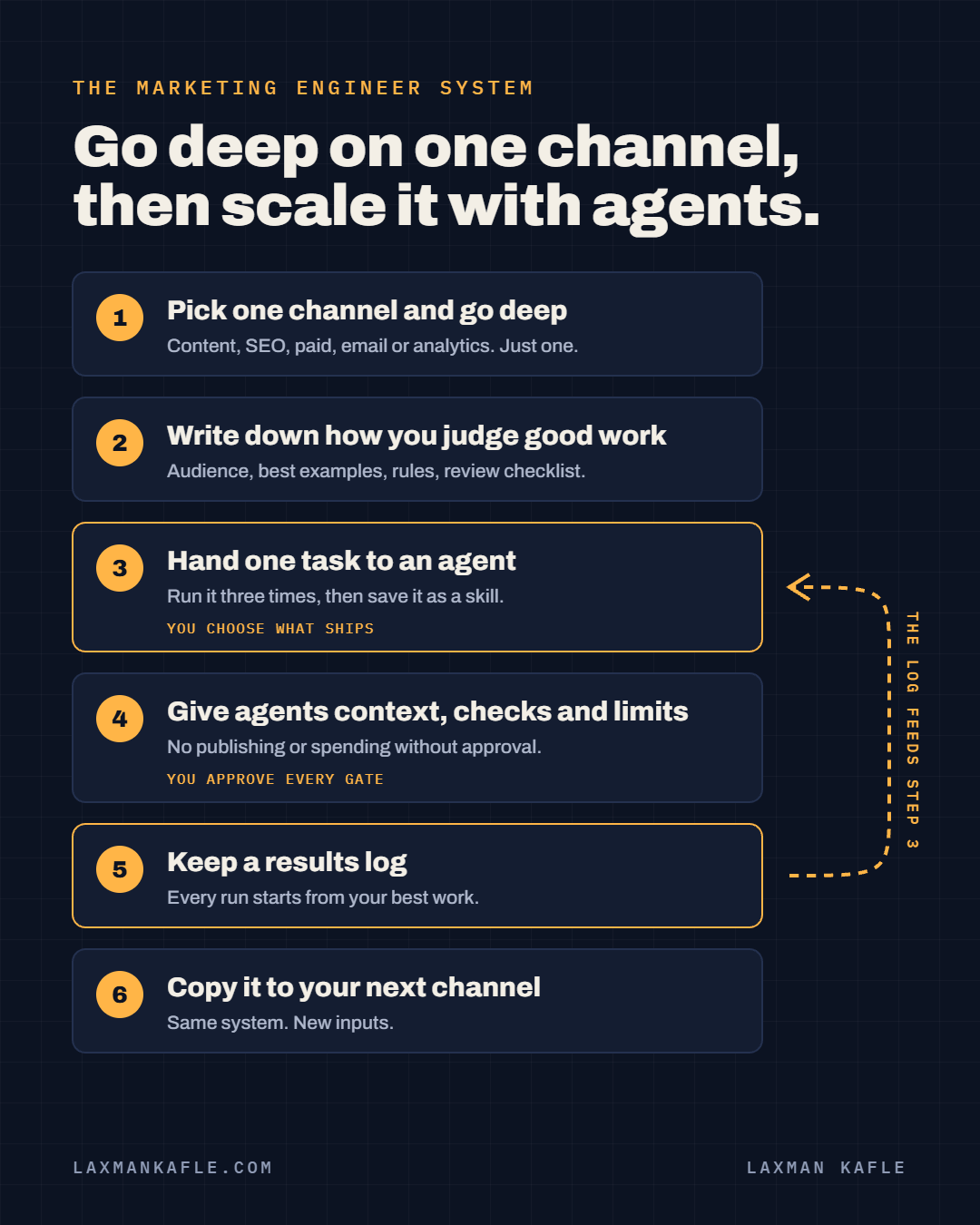
Step 1: Pick one channel and go deep
Choose the channel you already understand best: content, SEO, paid ads, email or analytics. Not three. One. Going deep means you can explain why a piece of work will perform before the numbers come in. You know what makes your buyers stop scrolling, what makes them trust you and what makes them pay.
This is the part AI cannot do for you. Taste, judgement and a feel for your audience come from doing the work yourself, many times. If you skip this step, everything that follows produces average work faster.
Step 2: Write down how you judge good work
Most marketers keep their best judgement in their heads. A marketing engineer writes it down. Before you touch an agent, write one page for your channel:
Who it is for. Your buyer, their problem and the words they use.
What good looks like. Three examples of your best work and why they worked.
Your rules. Tone, claims you never make, format, length, call to action.
Your checklist. The questions you ask when you review a junior's work.
If you cannot explain a task to a new hire in one page, you cannot explain it to an agent either. This page becomes your agent's instructions.
Step 3: Hand one task to an agent, then make it a skill
Do not try to automate your whole marketing department on day one. Pick one task you do every week and can judge in a minute. Run it with an agent, using your one-page guide. Fix what it gets wrong and update the guide. Do this three times.
When the output needs almost no fixing, save the instructions as a reusable skill: a file the agent follows every time, so you never explain the task again. Then put it on a schedule.
Here is how my weekly social content runs today, across X, LinkedIn and Facebook:
Collect. An agent gathers this week's customer questions and the topics my audience is discussing.
Angle. It proposes a handful of angles and explains why each one fits the audience.
Draft. It writes several versions in my voice, following my rules.
Check. It scores each draft against my checklist and flags weak claims.
Choose. I pick the strongest few and add the personal detail only I have.
Log. What I chose and how it performed goes into a log for next week.
My week of posts now takes a fraction of the time it used to, and most of that time is choosing and editing.
Step 4: Give your agents context, checks and limits
An agent without context writes generic copy. An agent without limits can spend your money. Every agent I run gets five things:
Context. Product facts, audience, offer, past campaigns and results.
A written process. The steps from your guide, in order.
A quality check. The agent reviews its own output against your checklist before you see it.
A schedule. A weekly content batch, a daily ad check, a Monday report.
Hard limits. What it may never do alone: publish, spend, email customers or change a live account.
This is also why I built Exepal, a set of marketing tools that AI agents can call and pay for per use. If agents are going to do the volume work of marketing, they need tools built for them.
Step 5: Keep a results log
This is the step that makes the system compound. After every run, record what happened: which posts got shared, which keywords moved, which ads converted, what you rejected and why. Keep it in plain files that both you and your agents can read.
Each new run starts by reading the log. Over a few weeks the agent learns your preferences, avoids last month's mistakes and starts from your best work instead of a blank page. My own projects keep a running log of decisions, results and mistakes, and it is the main reason the work gets faster every week.
Step 6: Copy the system to your next channel
Once one channel runs well, the same shape works elsewhere. Only the inputs change:
SEO: agents build keyword maps, briefs and first drafts. You add the answers that need real experience.
AI search: agents check which brands ChatGPT, Claude and Gemini recommend in your category, and where you are missing. You approve the fixes.
Paid ads: agents suggest angles and variations and watch performance daily. You approve every budget and creative.
Analytics: agents pull data, compare platforms and flag anything unusual. You read the summary and decide.
When we rewrote the SEO titles and descriptions for all 25 pages of this site, it was this system in practice: agents drafted, I approved every line, and the changes went live in a day.
The three approval gates
My most important rule: nothing goes live until a human signs it off. In practice that means three gates that no agent passes alone:
Before anything is published. Posts, pages, emails and replies.
Before any money moves. Budgets, bids, new campaigns and subscriptions.
Before a number drives a decision. A human reads the report before the plan changes.
Give an agent your ad account with no limits and you will learn this lesson the expensive way.
Three mistakes I see most often
Automating before mastering. If you cannot tell a good ad from a bad one, an agent producing 50 ads a day just gives you 50 bad ads faster.
No quality check. Teams accept whatever comes out. Make the agent review its own work against your checklist first.
No results log. Without one, every run starts from zero and you never compound.
How to start this week
Monday, choose your channel. Tuesday, write your one-page guide. Wednesday to Friday, run one task with an agent three times and improve the guide each time. By Friday you have your first skill and the first entries in your results log. That is a marketing engineer's first week.
I help founders and growth teams build this kind of system. If you would rather have it set up for you, here is how I work with teams. Otherwise, take the six steps above and start with one task.
Frequently asked questions
What does a marketing engineer do?
A marketing engineer designs and runs marketing systems. They master one channel, write down how good work is judged, and build AI agent workflows that research, draft, test and report, with a human approving the output.
Do I need to code to become a marketing engineer?
Not much. Modern agents follow plain-language instructions, so clear writing matters more than code. Basic comfort with files, spreadsheets, APIs and an agent tool such as Claude Code helps you go further.
What is the difference between a marketing engineer and a growth marketer?
A growth marketer runs experiments to grow a metric. A marketing engineer builds the systems and agents that run those experiments repeatedly. Many good growth marketers are becoming marketing engineers.
Which marketing tasks should I give AI agents first?
Start with repeatable tasks you can judge quickly: social post drafts, SEO briefs, ad angle variations and weekly reports. Keep publishing, spending and anything customer-facing behind human approval.
Will AI agents replace marketers?
They will replace a lot of marketing tasks, not marketers with taste and judgement. The marketers at risk are the ones who only execute. The ones who direct agents become far more valuable.
Agents multiply whatever you already know. If you know nothing, they multiply nothing.Post this on X →
Laxman Kafle
I am a serial entrepreneur and growth consultant with 15+ years in performance marketing and AI. I founded EveMoo Tech, Socialji and eVTOL.Travel, and I help founders and brands grow, quietly and under NDA.
Book a free 30-min growth callMore insights →